
When buying anodized aluminum tilee dge trim, anodized aluminum thickness is often a key requirement.
Clients may ask:
· What anodized aluminum thickness can you provide?
· Can you meet a required micron specification?
· How do you measure anodic film thickness?
· Is the anodized finish consistent across batches?
· Will aluminum tile trim profiles look uniform after installation?
These issues are of great importance. However, a single thickness test cannot fully reflect the quality of the metal tile decorative strips.
For the ceramic tile trim at the edges and corners of the tiles, the key lies in the stable thickness of the anodic oxide film and consistent surface smoothness. The finished outline should meet the project's requirements for appearance, durability, and usage conditions.
The average qualified thickness does not necessarily mean that each area of the outline has the same effect. Edges, grooves, corners, and complex areas may have different test results. In addition, after anodic oxidation, there may still be residual extrusion marks, scratches, operation imprints, and uneven surface textures.
How to Measure the Anodized Layer Thickness ?
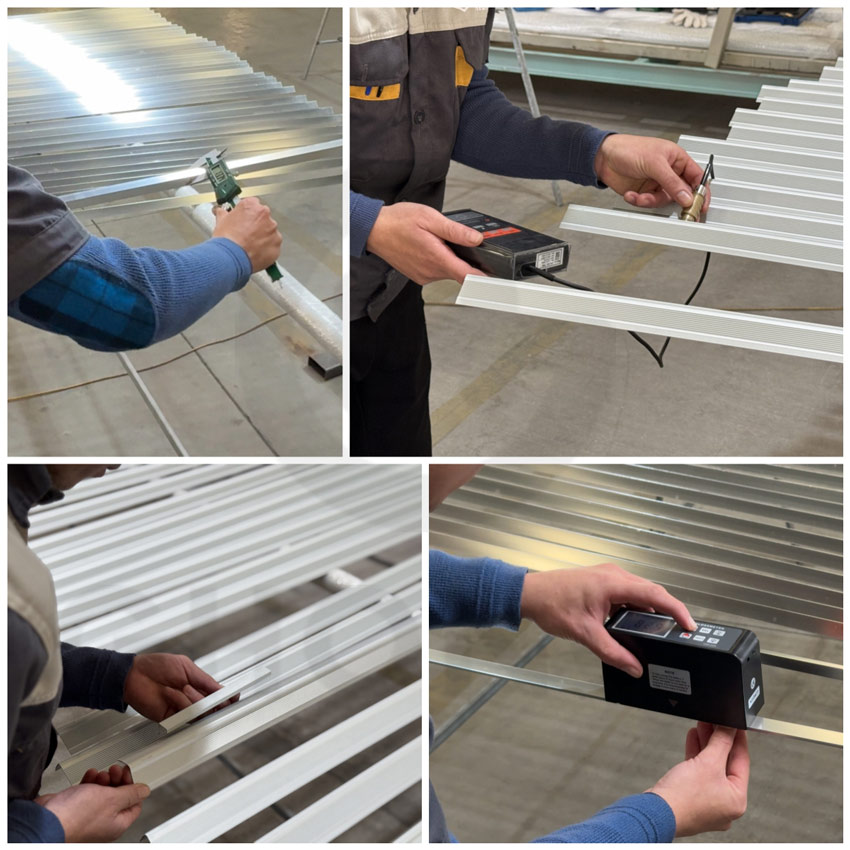
Eddy current testing is a commonly used method for measuring the thickness of anodized aluminum.
This is a non-destructive testing method. A calibrated probe is placed on the surface of the anodized aluminum, and the thickness measuring instrument can measure the non-conductive anodic oxide film on the conductive aluminum substrate. There is no need to cut or damage the profiles.
Eddy current thickness measurement is suitable for production inspection and final quality checks, enabling operators to conduct tests on multiple positions on a single aluminum decorative panel profile. It allows operators to test several locations on one aluminum tile trim profile.
Reliable anodic film thickness measurement requires:
· A gauge designed for anodized aluminum
· Calibration with a similar aluminum alloy and profile shape
· Stable probe contact during testing
· Multiple readings at representative locations
· Clear records of each measurement point
· Review of local thickness, average thickness, and minimum thickness when required
Sharp edges, narrow grooves, burrs, and curved sections may affect probe contact. These areas may require a different probe, a dedicated test method, or separate agreement on measurement locations.
For complex profiles or quality disputes, cross-section testing can provide additional confirmation. This method is destructive. It allows direct observation of the anodic film thickness on a cut profile section.
Why Average Anodized Aluminum Thickness Is Not Enough
Average anodized aluminum thickness is useful. It should still be reviewed together with the project specification and the required measurement points.
A profile can have an acceptable average thickness while one exposed area is thinner than the rest. This may be important for decorative aluminum tile trim, architectural profiles, and applications with strict appearance requirements.
Before production, buyers should confirm:
· Is the requirement based on average thickness, minimum local thickness, or both?
· Which surfaces are decorative or exposed after installation?
· Are edges, grooves, channels, and internal corners included in the inspection?
· How many readings are required for each profile or batch?
· What inspection records are required?
· Which standard or customer specification will be used for acceptance?
Clear requirements reduce disputes caused by different measurement locations or different acceptance methods.
What Affects Anodic Film Thickness Consistency?
Anodized aluminum thickness depends on more than anodizing time. Material condition, extrusion quality, surface condition, pretreatment, electrical contact, loading arrangement, and anodizing bath stability can all affect the result.
1. Die Precision and Extrusion Surface Quality
Anodizing does not remove extrusion defects. It may make them easier to see.
Visible extrusion lines, scratches, drag marks, rough areas, and uneven texture can remain visible after anodizing. This is important for tile trim profiles with brushed, polished, champagne, bronze, black, or other decorative finishes.
Die precision and stable extrusion help create a smoother aluminum surface. A stable extrusion surface supports a more consistent anodized finish.
2. Surface Protection During Handling
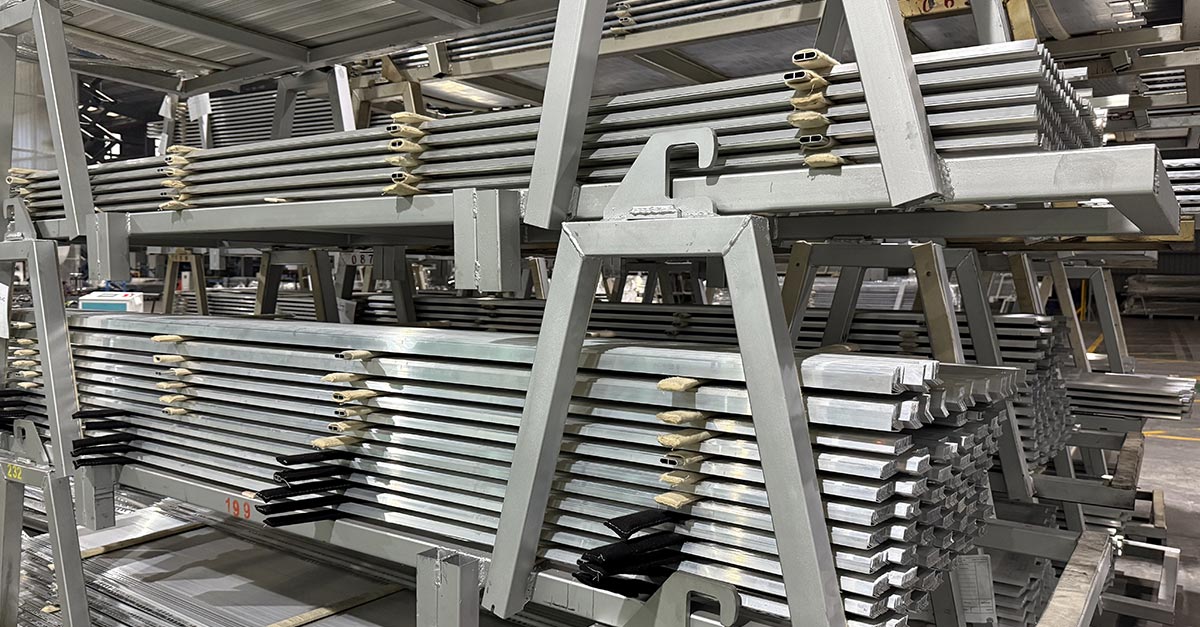
Aluminum tile trim profiles can be damaged after extrusion. Storage, transfer, packing, and transport all create potential risks.
Scratches, friction marks, pressure marks, and collision damage affect the surface appearance. Deep damage may remain visible after pretreatment and anodizing. It may appear as a difference in gloss, color, or texture.
Surface protection should include:
· Reduced metal-to-metal contact
· Clean separators and racks
· Protective packaging materials
· Careful transfer of long profiles
· Protection for visible decorative surfaces
· Clear handling rules for high-appearance orders
Qualified aluminum finishes need protection before, during, and after anodizing.
3. Pretreatment Consistency
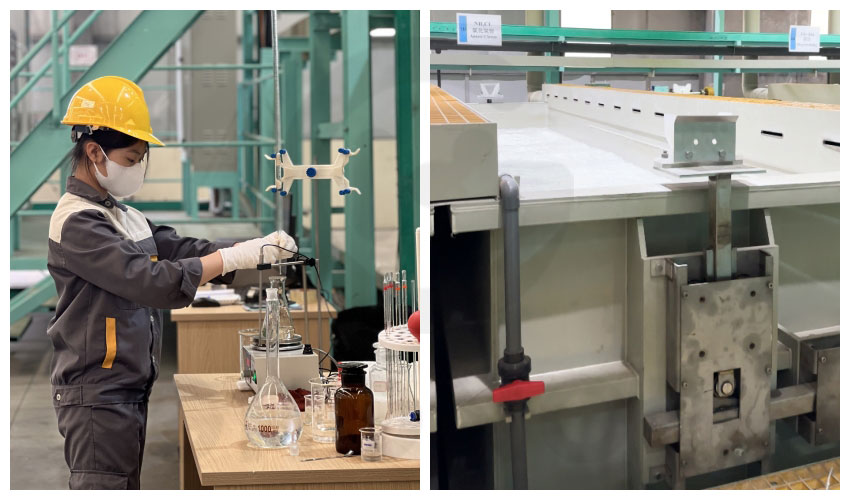
Pre-treatment is used to protect the aluminum surface to ensure the effectiveness of anodizing. Depending on the desired surface effect, this process may include steps such as cleaning, etching, neutralization and brightening.
Inconsistent pre-treatment can lead to uneven surface reactions during anodizing, thereby affecting gloss, texture, color appearance and surface consistency.
Pre-treatment should be strictly managed as part of the quality control for anodizing.
4. Electrical Contact and Profile Loading
Stable electrical contact is important for anodized aluminum thickness control.
Poor contact between the aluminum profile and the fixture can affect current distribution. Profile geometry, hanging direction, loading density, contact location, and fixture design can also affect anodic film thickness.
Long tile trim profiles, deep profiles, and complex aluminum sections need suitable loading arrangements. The goal is stable current distribution across the profile surface.
5. Anodizing Bath Stability
Anodizing bath conditions affect anodic film thickness and finish consistency.
Key factors include solution composition, concentration, temperature, circulation, bath uniformity, electrical settings, anodizing time, and loading conditions.
Large changes in bath conditions can lead to thickness variation between batches, positions, or areas of the same profile.
A controlled anodizing process should include:
· Defined operating ranges for bath composition
· Regular bath analysis and replenishment
· Temperature control
· Adequate solution circulation or agitation
· Monitoring of process changes
· Inspection and production records for traceability
Our Quality Control Approach for Anodized Aluminum Tile Trim
At Ghonor, we treat anodized aluminum thickness as a process result.
Final thickness inspection is necessary. It confirms whether the anodic film thickness meets the agreed requirement. However, stable thickness starts earlier in production.
Our production focus includes:
· Die precision and extrusion surface quality
· Reduction of extrusion lines and avoidable defects
· Surface protection during storage and handling
· Consistent pretreatment conditions
· Reliable electrical contact and profile loading
· Controlled anodizing bath conditions
· Multi-point anodized aluminum thickness inspection
· Process and inspection records for traceability
This approach helps reduce surface variation between profiles and batches.
How to Select the Right Anodized Film Thickness
A higher thickness of anodized aluminum is not always the best choice.
The thickness of the anodic oxide film should be matched to the actual application. Key factors include the installation environment, corrosion resistance requirements, decorative effect, profile shape, dimensional tolerance, and project budget.
For indoor tile decoration, damp areas, outdoor projects, coastal environments, and high-wear applications, different anodized specifications may be needed.
The correct specification is not merely the highest micron value, but the anodized aluminum thickness and surface treatment system that meet the project requirements.
Questions to Ask Before Ordering Anodized Aluminum Tile Trim
As a buyer, before placing an order, you would need to ask:
· What is the film thickness is required?
· Is the requirement based on average thickness, minimum local thickness, or both?
· Which profile areas will be measured?
· How is the thickness gauge calibrated?
· How many readings are taken per profile or batch?
· How are decorative surfaces protected during production and transport?
· How are anodizing bath conditions controlled?
· Can the supplier provide inspection records and batch traceability?
Consistent Anodic Film Thickness Supports a Better Finish
Anodized aluminum quality should not be judged by one reading from one location.
Consistent anodic film thickness depends on stable extrusion, good surface condition, controlled pretreatment, reliable electrical contact, stable anodizing bath conditions, and multi-point inspection.
Uniform thickness of anodized tile edge metal trim is an important foundation for achieving consistent surface effects. The final appearance also depends on surface quality, pre-treatment, anodizing conditions, sealing quality, and precise processing operations.
If you are purchasing tile edging strip or anodized tile metal edge trim, please contact Ghonor to discuss with us the required anodized aluminum thickness, surface treatment requirements, and quality control needs for your project.
Previous None
Copyright © Foshan Golden Honor Decorative Material Co., Ltd.All Rights Reserved
Sitemap | Technical Support: