
The selection of decorative aluminum tile trim profiles is not only based on their shape, dimensional accuracy or corrosion resistance, but also on their surface treatment effect. In many applications, the surface treatment is one of the most prominent parts of the final product.
Whether it is used for architectural decorative lines, tile borders, skirting boards, wall panels, cabinet frames, furniture details, retail display stands, display systems, led light channels or decorative metal components, anodized aluminum is usually installed in continuous and highly visible areas.
For this reason, customers expect more than an attractive surface on an individual sample.
They expect consistent color, uniform appearance, and reliable finish quality across an entire production order.
Achieving that result requires more than selecting a color and placing profiles into a treatment tank. It requires stable process control.
At Ghonor, we believe fully automated mechanical anodizing is better suited to decorative aluminum profiles because it reduces avoidable variation in time-sensitive and chemistry-sensitive production stages. In particular, it helps control dyeing time, supports more uniform anodizing conditions, and improves the repeatability required for large-volume orders and repeat purchases.
Why color consistency matters in aluminum tile trims
A slight shade variation may be difficult to identify when a single profile is inspected on its own.
The situation changes after installation.
When anodized aluminum tile edge trims are placed side by side along a wall, floor edge, ceiling, door frame, facade system, cabinet, or display structure, small differences in tone, brightness, or surface, uniformity can become noticeable. This may affect the overall appearance of the project even when individual profiles appear acceptable before installation.
For importers, distributors, contractors, fabricators, and product brands, inconsistent anodized color can create several commercial risks:
Project delays caused by sorting, replacement, or rework
Higher costs related to rejected materials and additional freight
Difficulty matching a later replenishment order to the original shipment
Customer complaints after installation
Reduced confidence in the supplierʼs quality-control capability
Damage to the visual consistency of a branded product line or completed project
Therefore, color consistency should be treated as a manufacturing-control issue, not only as a final inspection issue.
What causes uneven anodized color?
Anodized color is the outcome of a sequence of controlled chemical and electrochemical processes. The final appearance can be influenced by multiple variables, including:
Aluminum alloy composition and material condition
Extrusion consistency and surface quality
Mechanical finishing and pretreatment quality
Cleaning and etching conditions
Anodizing time, voltage, current density, temperature, and electrolyte condition
Anodic film formation and uniformity
Dye concentration, temperature, ph, and dyeing duration
Transfer time between tanks
Racking design and electrical contact quality
Sealing conditions and post-treatment handling
Because these variables interact, color variation is rarely caused by only one factor. A consistent decorative finish requires the manufacturer to control the entire sequence rather than relying on final visual sorting. This is particularly important for anodized finishes where color is developed through the interaction between the anodic film and the coloring process. If the anodized layer forms unevenly, color absorption can also become uneven.
The limitation of manual timing
A manually controlled dyeing process can increase the risk of:
Shade variation between production loads
Color inconsistency between shifts
Differences between the beginning and end of a production run
Difficulty reproducing an approved finish in repeat orders
Greater dependence on individual operator experience
For buyers, this means that the quality of an anodized finish can become less predictable when critical timing depends primarily on manual control.
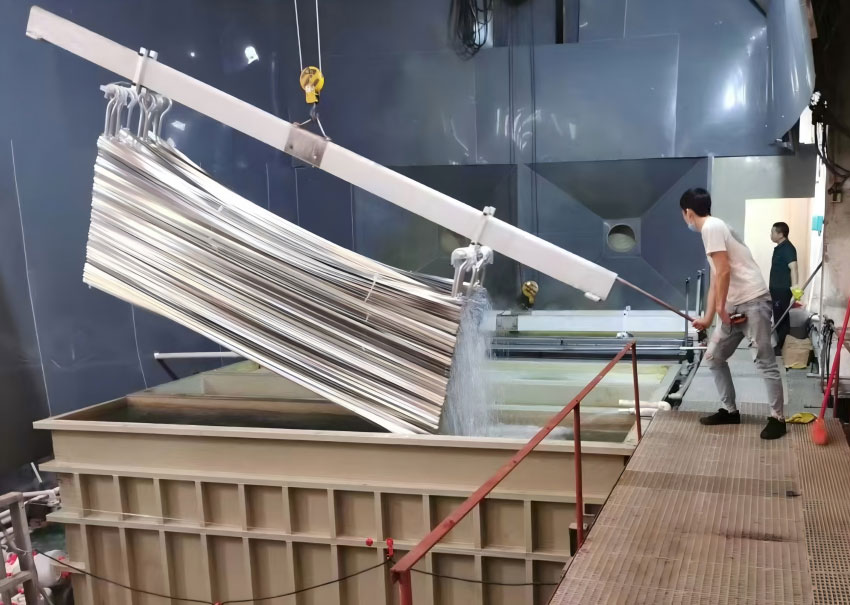
Our fully automated mechanical anodizing approach
Our fully automated mechanical anodizing line is designed to make key process stages more repeatable.
The system controls the programmed movement of profile loads through the anodizing and coloring sequence. This includes controlled immersion, holding, lifting, and transfer actions according to established processing parameters. Instead of allowing dyeing time to depend mainly on manual operator judgement, the equipment applies a defined treatment cycle for each load. This helps us control one of the most important variables affecting decorative color: The time that profiles remain in the dyeing solution.
The benefit is practical. When the same product, finish, and process recipe are being produced, each load can follow the same programmed dyeing duration and transfer rhythm. This reduces unnecessary variation caused by differences in manual timing.
Our aim is not to claim that automation can remove every possible source of color difference. Rather, our objective is to reduce the controllable variation that can affect the consistency of decorative anodized finishes.
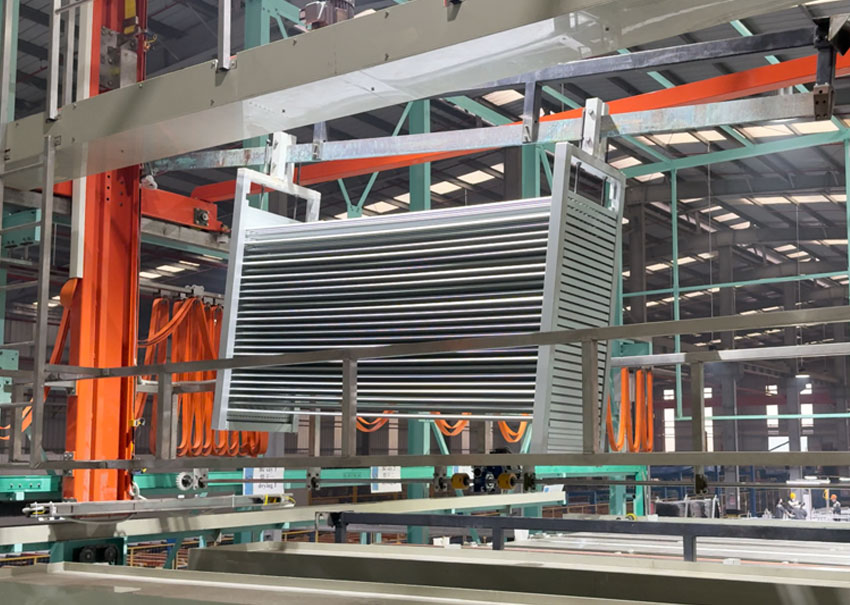
Automatic tank mixing for uniform anodizing conditions
The coloring stage receives much of the attention when discussing anodized appearance. However, the anodization stage is equally important.
Before dyeing, the aluminum surface must form an anodic oxide layer. The condition and uniformity of this layer influence how the surface responds during coloring and sealing.
If the electrolyte concentration is not uniform throughout the anodizing tank, profiles positioned in different areas may be exposed to slightly different chemical conditions. This can contribute to variation in anodic-layer formation and may affect the uniformity of the final decorative surface.
To support more stable anodization conditions, our anodizing tanks are equipped with an automatic mixing system. The automatic mixing system helps maintain a more uniform electrolyte concentration throughout the bath. Rather than allowing localized concentration differences to remain in the tank, controlled mixing supports a more consistent treatment environment for the profiles.
This is especially valuable for products where customers expect a refined, continuous, and visually consistent anodized finish.
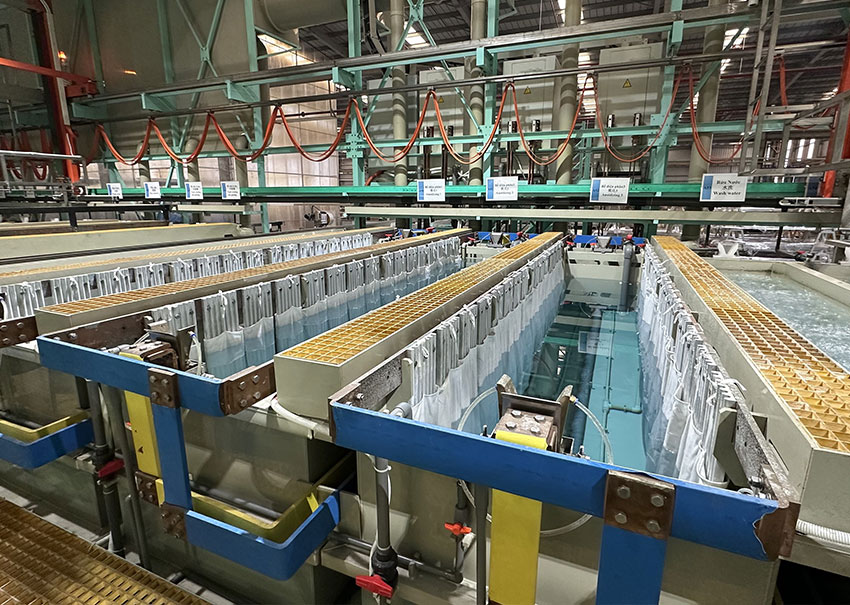
Automation supports repeatability
Repeatability is one of the most important capabilities in decorative aluminum manufacturing. A supplier may be able to produce an acceptable anodized sample through careful adjustment and manual supervision. But mass production requires something more demanding: The ability to reproduce the same finish consistently across many racks, shifts, production dates, and repeat orders.
A fully automated mechanical anodizing line supports this objective by helping standardize with key process actions and automation is therefore not only about production efficiency. For decorative anodizing, it is a tool for controlling the manufacturing conditions that influence visual quality.
Automation works with quality control
A professional anodizing process requires more than automated equipment. Even the best automation system must be supported by suitable material selection, stable extrusion, controlled pretreatment, correct racking, bath maintenance, process monitoring, and final inspection. Our approach is based on the principle that surface consistency is created before final inspection. Inspection can identify visible issues, but it cannot fully replace process control.
For this reason, we view automated anodizing as part of a broader manufacturing discipline that includes:
Selection of suitable aluminum materials for the specified finish
Control of extrusion surface quality before anodizing
Standardized cleaning, etching, and pretreatment procedures
Defined anodizing and coloring process parameters
Automated control of dyeing time and process movement
Automatic mixing to help stabilize anodizing-bath conditions
Routine monitoring and maintenance of process solutions
Visual checks for surface uniformity and color consistency
Batch-based process records and continuous improvement
This integrated approach is more reliable than relying solely on operator judgement or final sorting.
A better basis for decorative aluminum profiles supply
Decorative aluminum tile edging strip is judged in the finished environment, not only in the factory. Customers need profiles that can be installed together with a consistent appearance. They also need confidence that future orders can be manufactured under controlled conditions, not recreated through trial and error.
Our fully automated mechanical anodizing line is built to support that requirement. By controlling dyeing time through programmed mechanical movement, we reduce the variation that can occur when workers manually determine immersion duration. By using an automatic mixing system in the anodizing tank, we help maintain a more uniform electrolyte concentration and support more consistent surface anodization. The result is a manufacturing process designed for what decorative aluminum customers value most: Stable color, uniform surface quality, better repeatability, and greater confidence from approved sample to mass production and repeat orders.
Copyright © Foshan Golden Honor Decorative Material Co., Ltd.All Rights Reserved
Sitemap | Technical Support: