
Importing aluminum alloy extrusion products into the United States requires a careful look at suppliers’ total supply chain costs. Buyers must evaluate tariffs, country-of-origin rules, and production stability rather than just looking at the initial factory price. The trade landscape between the U.S., China, and Vietnam can directly impact your bottom line. In this article, we will break down both the actual costs and logistics of sourcing from these 2 regions; assist you in having a clearer understanding of when to pick which.
I. U.S. Tariffs on Chinese Aluminum Products
Importers bringing aluminum extrusion products from China to the U.S. face a complex combination of duties. These charges accumulate quickly and include basic import duties, Section 232 steel and aluminum tariffs, and Section 301 additional tariffs. If a specific product category falls under anti-dumping or countervailing duty investigations, the total tax rate can become exceptionally high.
The Office of the USTR (United States Trade Representative) places steel and aluminum in a strategic sector. Due to classification, Section 301 tariffs apply strictly to aluminum from China.
In 2025, the States leveled up additional tariffs on imported aluminum materials to 25%, with an increase up to 50% scheduled for the following June in the same year. These updates create a heavier financial burden and make the Chinese tariff structure highly volatile for U.S. buyers.
II. U.S. Tariffs on Vietnamese Aluminum Products
Aluminum alloy products originating from Vietnam help buyers avoid the specific Section 301 tariff pressures aimed at China. Yet not all these products are tax-free. Still, the Vietnamese aluminum imports must comply with broad Section 232 tariffs. They also face strict country-of-origin verification from CBP(U.S. Customs and Border Protection ).
Vietnam operates as an independent manufacturing alternative rather than a simple transit point. If CBP officials suspect that a product only underwent minimal processing or simple transshipment in Vietnam, they will apply heavy penalties. Furthermore, U.S. trade policy regarding Vietnamese goods continues to evolve. Importers sholuld ensure their supply chain relies on genuine and thorough manufacturing within Vietnam to maintain long-term compliance.
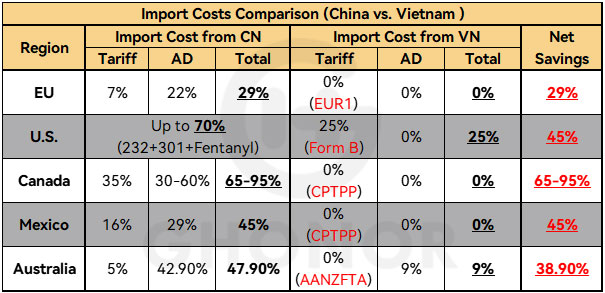
III. Manufacturing Cost Comparison: China vs. Vietnam
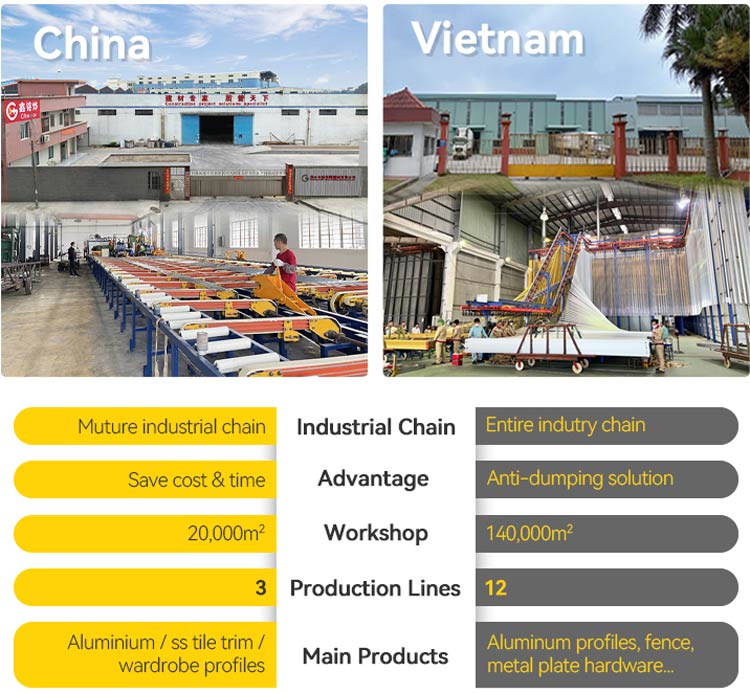
The financial differences between China and Vietnam manufacture go beyond basic hourly wages. True cost efficiency depends on raw material access, energy expenses, production yields, tooling infrastructure, and the surrounding industrial network.
Vietnam excels in keeping labor costs low. This advantage makes the country ideal for standard aluminum alloy extrusion profiles that require simple processing but higher manual labor. China offers a highly concentrated supplier base and advanced machinery infrastructure. For complex cross-sections, strict tolerance requirements, or extensive surface finishing, Chinese factories often maintain a lower overall production cost due to their high yield rates.
IV. Sourcing Logic for U.S. Importers
What factors drive a U.S. business to choose one country over the other? Buyers focus heavily on the total landed cost. This final calculation includes the factory price, international logistics, customs duties, lead times, and the cost of potential quality risks.
* The China Option: Offers reliable delivery, a mature supply chain, and the ability to manufacture highly specialized technical designs.
* The Vietnam Option: Provides a safer tax structure against specific trade wars, lower labor costs, and an excellent alternative to diversify supply chain risks.
Importers generally split their orders based on product type. Standardized items move toward Vietnamese production, while highly customized or time-sensitive projects remain with established Chinese facilities.
V. Beyond the Factory Unit Price
Focusing only on the initial factory quote is a common mistake for sourcing departments. Once you combine all the costs (Section 232 duties, Section 301 taxes, freight transit times, and potential quality control fluctuations), the final landed price on your side often looks completely different from the original estimate.
This variation is especially visible in aluminum building materials. Window frames, curtain wall profiles, tile trims, and industrial assembly parts all carry different tariff classifications and origin rules. You cannot judge these diverse items by a single sourcing standard. Because of these complexities, modern U.S. buyers prioritize suppliers with proven compliance capabilities and stable delivery networks over factories that simply offer the lowest raw quote.
VI. Dual-Base Manufacturing Solutions
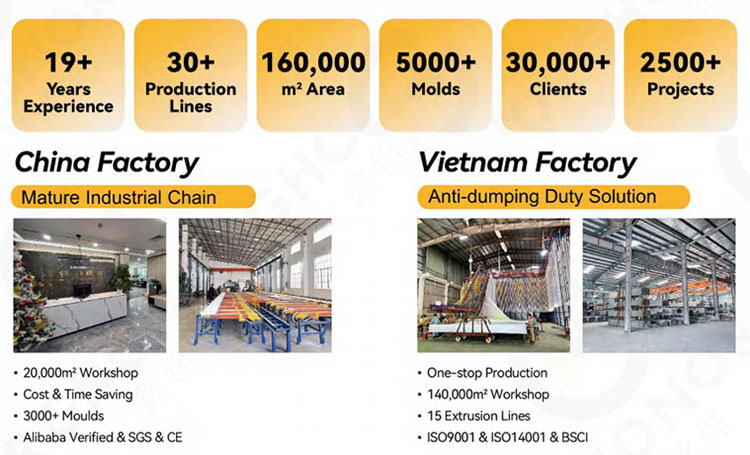
Ghonor solves these trade challenges by operating a dual-base manufacturing system. Originated from China, we made it to expande our industrial chain through setting a 140,000-square-meter factory in Vietnam. The infrastructure allows us to optimize the export logistics and utilize various trade agreements (e.g. FORM B). We ship your orders directly from our Vietnam facility, helping you lower import tariffs and avoid heavy anti-dumping duties.
Our dual-base layout gives U.S. clients excellent flexibility to balance production costs, tariff exposures, and shipping timelines. We handle the entire process, including extrusion production, surface treatments, customs documentation, and final shipment logistics. This comprehensive management protects your business from relying on a single sourcing origin.
Conclusion
Choosing either China or Vietnam manufacturer for aluminum extrusion profile sourcing requires the balance of post-tax costs, supply chain reliability, and trade compliance. The best procurement strategy relies on a sustainable partnership that can minimize total landed cost while keeping financial and legal risks totally under control. Contact Ghonor today to review your project specifications and establish a secure, tariff-optimized supply chain.
Copyright © Foshan Golden Honor Decorative Material Co., Ltd.All Rights Reserved
Sitemap | Privacy Policy | Technical Support: