
Selecting the appropriate aluminum tile trim profile is not only a design decision but also impacts installation efficiency, inventory planning, product positioning, and customer satisfaction for distributors, contractors, and project buyers.
Among common aluminum tile edge trim designs, L-shaped straight angle trim and quardrant round tile profiles are frequently chosen for different reasons. Both effectively protect exposed tile edges and deliver clean, aesthetically pleasing finishes. However, they may differ significantly in typical application scenarios, final visual effect, and market demand.
Based on our existing 19+ years of manufacturing experience with repeated order history, and customer feedback, the L-shaped aluminum corner trim—being versatile and widely used—typically demonstrate broad and consistent market demand. In contrast, rounded profiles remain an important choice in applications requiring soft visual transitions or smooth edge details.
The right selection depends on specific projects, target customers, local design preferences, and overall product strategy.
What Is L-Shaped Aluminum Tile Trim?
L-shaped aluminum tile trim has a straight-edge decorative surface designed to protect and finish exposed tile exterior edges. Its clean, linear geometric line makes it suitable for a wide range of residential, commercial, and renovational projects.
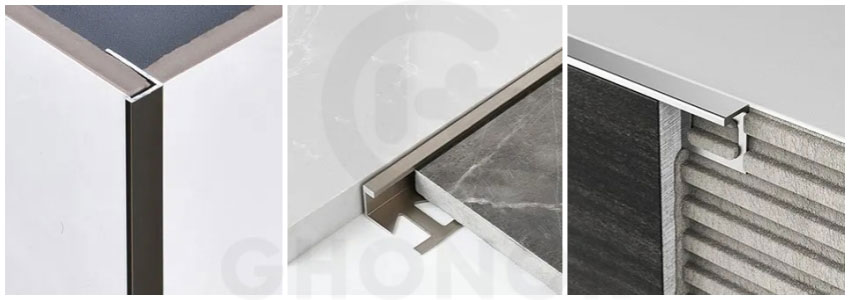
It is commonly used for:
· External wall tile corners
· Backsplashes and kitchen wall edges
· Bathroom wall finishes
· Window returns and niche edges
· Floor-to-wall transitions and decorative tile borders
For distributors and wholesalers, L-shaped profiles often act as a practical core of the inventory; for easy to match with various indoor areas, compatible with a wide range of common tile styles with attractive appearance.
What Is Round Edge Aluminum Tile Trim?
Round edge aluminum tile trim features a curved to a certain degree or rounded visible edge. Compared with a straight L-shaped profile, it creates a softer transition at the tile edge and can provide a more decorative appearance, with practical safer element added to the indoor areas where physical contacts are easily occured in human everyday activities.
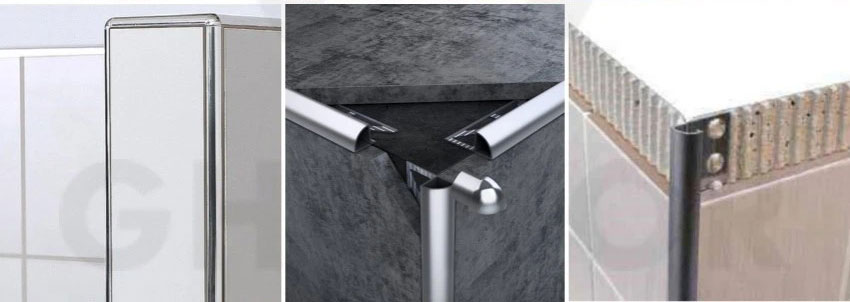
It is commonly selected for:
· Countertops and wet areas edges
· Family-oriented residential projects
· Curved or softer interior design schemes
· Feature walls and decorative tile installations
· Projects where a rounded finish is preferred over a sharp linear edge
Round edge trim is not a replacement for L-shaped trim. It serves a different visual and application purpose. For many buyers, it is an important complementary item within a complete tile trim range.
What Our Order Experience Has Taught Us
Neither profile is universally better. The correct decision depends on the tile application and the requirements of the target market. Sometimes we manufacturers may think that the most visually striking design will also become the most widely adopted one.
However, in reality, customers tend to place more emphasis on other factors: ease of standardization, wide applicability, local purchasing habits, installation familiarity, and reliable supply capacity.
This has been an important lesson in our own product planning.
For many years, round edge tile trim was one of the profiles we strongly recommended because of its smooth appearance and decorative potential. However, when we reviewed long-term order patterns and customer feedback, L-shaped profiles consistently showed more stable general demand in many of the markets we serve.
This does not mean that round edge profiles are less important. Instead, it highlights a practical principle for tile trim sourcing: A manufacturer's preferred design is not always the market's most frequently selected solution.
For this reason, we evaluate product demand through more than one factor, including order frequency, repeat purchasing patterns, customer feedback, project applications, finish preferences, and regional buying behavior.
Therefore, we evaluate product requirements based on multiple factors, including order frequency, repeat purchase patterns, customer feedback, project application scenarios, surface treatment preferences, and regional purchasing behaviors.
How to Choose the Right Tile Trim Profile for Projects
Before choosing aluminum tile trim profiles with L-shaped or circular edges, consider the following questions:
1. What is the tile thickness?
The trim height should match the tile thickness and allow for the installation adhesive layer. We recommend 1-2mm higher than the tiles; Always confirm the actual tile thickness before finalizing the profile size.
2. What is the application?
A straight L-shaped profile is often a practical choice for standard wall edges, external corners, and high-volume projects. A round edge profile may be more suitable where the design calls for a softer edge treatment.
3. Who is the end customer?
Contractors may prioritize easy installation and standard sizes. Retail buyers may focus more on color, finish, and appearance. Project buyers may require consistent quality, packaging, certification documents, and supply stability.
4. Which finish matches the project?
Universial options: mill finish, polished, brushed, anodized and powder-coated in available customized colors. The finish should complement the tile, fittings, and overall interior design.
5. What should be stocked as core inventory?
For many distributors, L-shaped profiles can form the foundation of a general tile trim range, while round edge profiles can expand design options and serve more specialized customer preferences.
Build a Product Range Around Real Demand
A successful aluminum tile trim range should balance universal products with differentiated options.
L-shaped profiles can provide broad, practical coverage for everyday applications. Round edge profiles can add visual variety and support customers looking for a softer or more decorative finish. Together, they help distributors and project buyers offer more complete solutions without treating one profile as the answer to every application.
At Ghonor, we manufacture aluminum tile trim strips based on practical application requirements, customer feedback, and extensive export experience. Our product range includes L-shaped, rounded shape, angle corner, T-shaped, and U-shaped, as well as floor protection series such as stair nosing, floor edging strip, carpet trim, and tile movement joint; custom aluminum profiles available in various sizes, surface finishes, lengths, and packaging options.
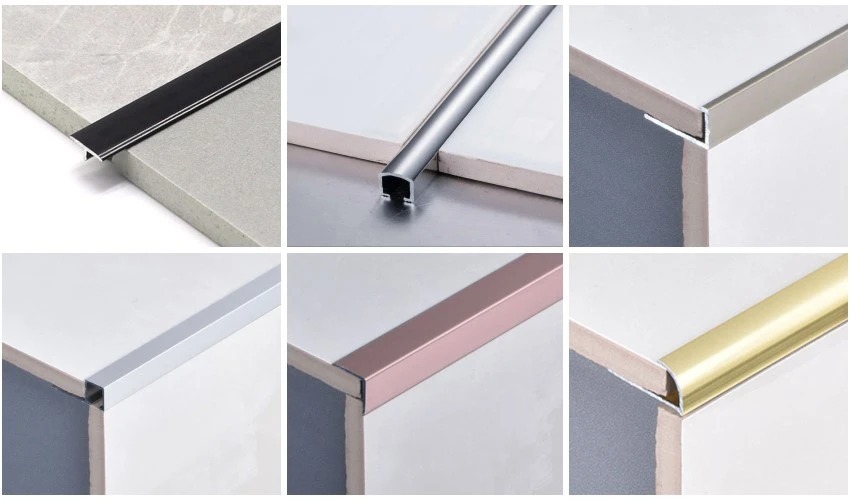
Ghonor Factory Strength
Ghonor has two factories: headquarters in China and an overseas base in Vietnam( with one another underconstruction in Cambodia).
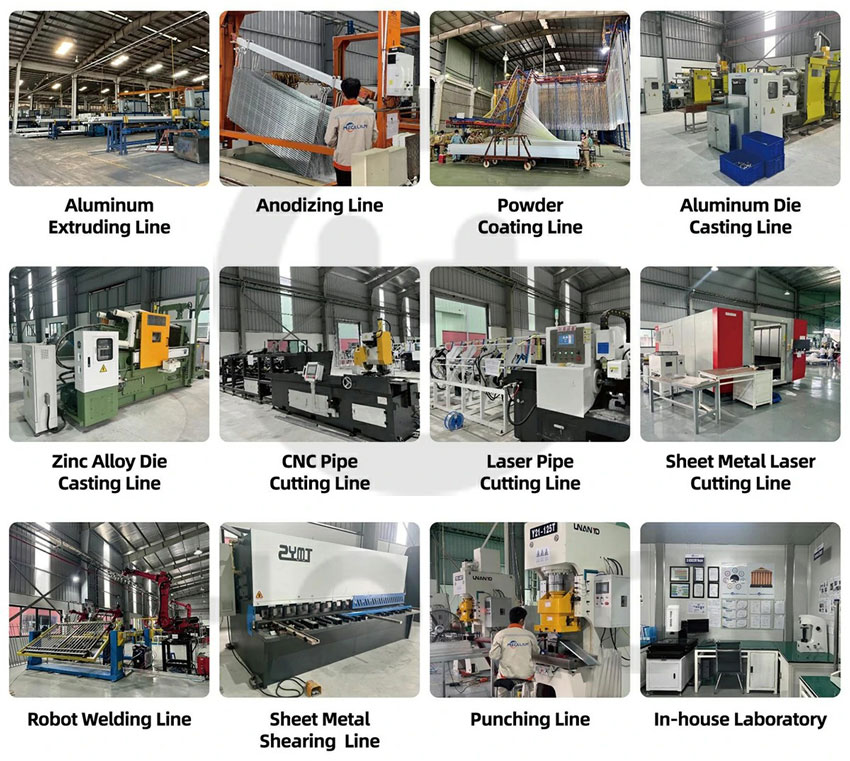
Our production bases cover an overall area of over 160,000 square meters with 15 production lines. They specialize in manufacturing aluminum tile trim, stainless steel(201/304/316 grade) tile trim, PVC tile trims, SPC tile trims, anti-slip stair edging strip, baseboards, floor transition strips, carpet trims, tile expansion joints, aluminum handles, aluminum cabinet door frames, photo frames, custom aluminum extrusion profiles, die casting hardware, tile leveling systems, tile grout, floor drain, etc.
Through continuous research and innovation, they produce more products that meet customer needs.
Need to select the right aluminum trim profile for your market or project? Contact our team to discuss samples, specifications, OEM options, and product range planning.
Previous None
Copyright © Foshan Golden Honor Decorative Material Co., Ltd.All Rights Reserved
Sitemap | Technical Support: