
A finish can look right on one short sample and quite different after twenty trims are installed on the same wall. That is why we suggest choosing from the final application backwards, rather than starting with a color name.
For most interior projects:
- Choose anodized brush/hairline for visible metallic grain and easier maintenance.
- Pick anodized matte for a smooth and softer look on long or repeated profiles.
- Use anodized polish where the trim is meant to catch the eye.
- Consider stone effect or textured powder coating when the design needs an opaque color or a tactile surface.
Lighting, tile color, cleaning easiness, and batch size still need to be considered.
Match the Finish to the Space
Anodized Brush keeps a clear metal character. Its grain texture helps small handling marks and flaws, daily use fingerprints less noticeable.
Anodized Matte’s less light reflection characteristics is practical for skirting, picture frames, and long trims less light and sits quietly beside tile, stone, wood, or painted walls.
Polished anodized is brighter and more decorative. It works as an accent, but fingerprints, fine scratches, and extrusion lines are easier to see. One sample may look impressive yet feel too bright across a large area.
Textured powder coating and stone effect belong to another finish system. Use them for an opaque, tactile surface or to coordinate with ceramic and stone.
No finish is scratch-proof. Matte and textured surfaces may hide minor marks, but resistance still depends on the specification.
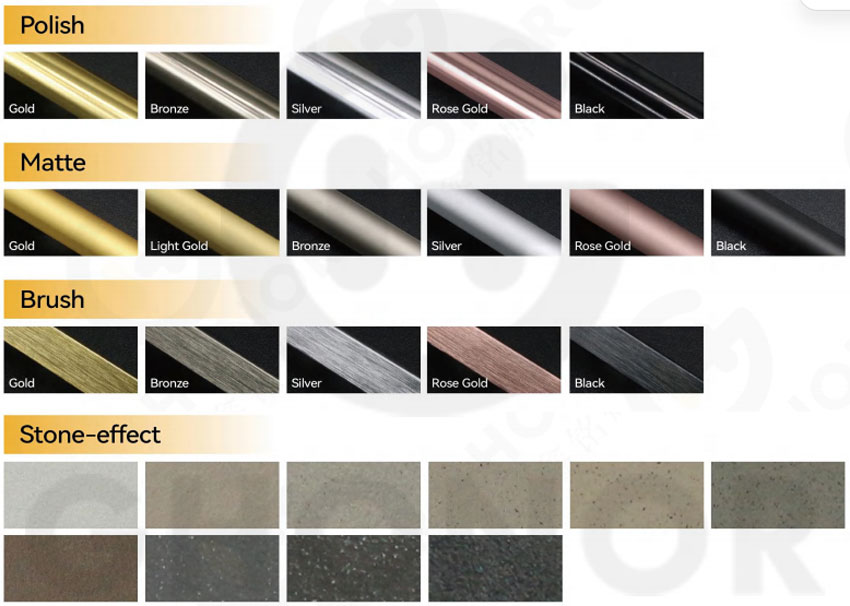
Brushed, Polished and Matte Describe the Surface Before Anodizing
This point is often missed. Brushing, polishing, or matte preparation happens first and remains visible. Then comes the anodizing forms an oxide layer from the aluminum itself.
So “black anodized” is not a complete finish instruction. Buyers also should confirm the required surface condition as two trims may still look different with the same color name.
Approve the Finish as It Will Be Installed
Do not approve a custom finish from a screen image or one small piece. The color of anodized coating will vary depending on the alloy, extrusion conditions, preparation method, film thickness, coloring, sealing, light exposure and observation angle.
Place several profiles together. Inspect the surfaces, grooves, corners and cutting edges under the light near the construction site. The profiles that meet at the same area should be approved as a group.
For custom colors, please keep the approved master sample and agree on the boundaries between light and dark colors. After that, subsequent orders can follow the same standards.
Lock the Bulk Standard Before Production
Before mass production, confirm:
- alloy, temper, drawing, and tolerances;
- visible surfaces and preparation method;
- finish, color, gloss, and texture;
- approved sample and color range;
- anodic film or powder coating requirements;
- inspection, defect limits, packaging, and traceability.
A good sample proves only that one piece can be made. The real test is repeating it through the order.
Ghonor Controls the Finish Before, During and After Anodizing
Our control starts before anodizing. Semi-finished profiles are separated during transfer and storage to reduce scratches and contact marks. Racking and electrical contact are strictly monitored to prevent affecting film formation and color.
Through out the production, we control anodizing parameters and compare the batch difference with the approved reference at several points. Handling and packaging follow the same route. The profiles received should match the finish approved at sampling.
Ghonor's triple manufacturing bases ensure the best flexibility and quality consistency we can offer. With headquarters in China, we established 2 more overseas factories to meet varid and expanded production needs in Vietnam and Cambodia. ISO 9001 and ISO 14001 management-system certification are prepared. Both locations support amfori BSCI and CBAM-related customer requirements.

Previous None
Copyright © Foshan Golden Honor Building Materials Co., Ltd.All Rights Reserved
Sitemap | Privacy Policy | Technical Support: