
For aluminum extruded profiles used for decorative purposes, the surface quality not only depends on the appearance, but also on its consistency, durability and the repeatability of mass production.
During the production of aluminum materials for indoor, architectural and commercial projects, even minor differences in color, gloss or the thickness of the anodized film can affect the final installation effect and the overall quality of the project. Therefore, to achieve a stable anodized surface, not only standard process parameters are required, but also a fully controllable production system is necessary.
1. Surface Protection Before Anodizing
Surface defects introduced before anodizing cannot be corrected later—they are often amplified during the finishing process.
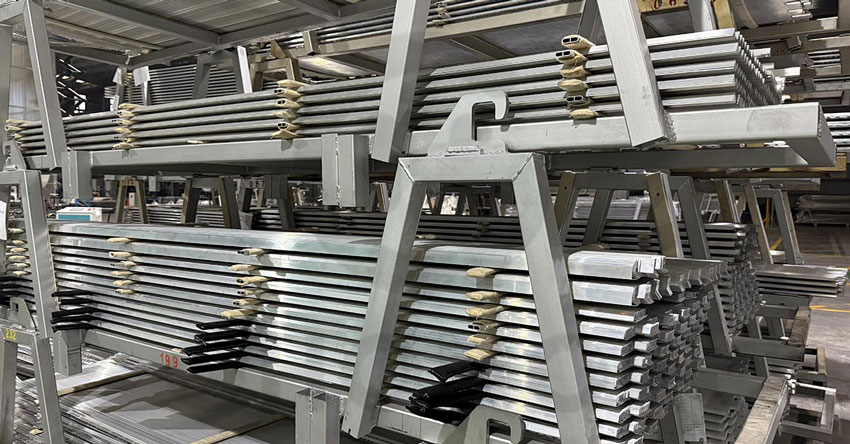
To prevent this, we implement controlled storage and handling procedures for semi-finished aluminum profiles:
· Spaced storage between layers and individual profiles to reduce contact damage
· Optimized process layout to minimize unnecessary movement
· Automated conveyors after punching to separate parts and prevent scratches
These measures help maintain surface integrity and improve overall yield, especially for large-volume decorative projects.
2. Electrical Contact Design in Anodizing
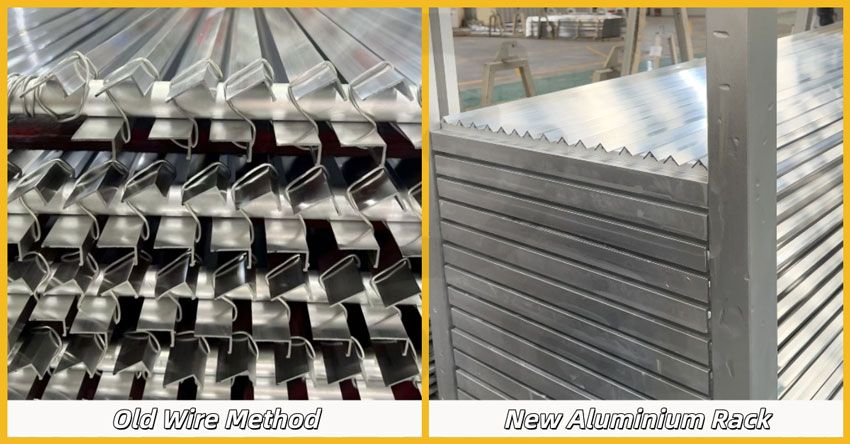
Electrical contact stability is a critical factor in anodizing quality, directly influencing current distribution and oxide film formation.
Unstable contact can result in:
· Uneven oxide film thickness
· Color inconsistency across profiles
· Visible contact marks
To improve conductivity and stability, we use a pure copper–aluminum contact structure instead of conventional aluminum wire connections. This enhances current transfer consistency throughout the anodizing process and supports uniform surface finishing.
3. Automated Anodizing for Process Stability
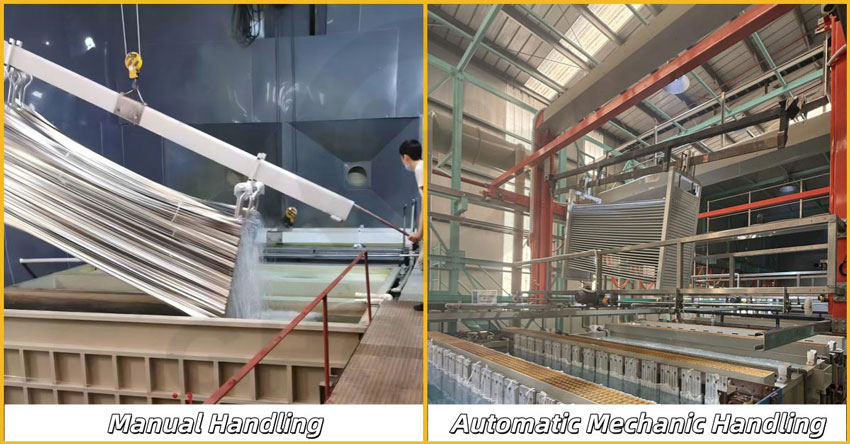
Traditional manual anodizing relies heavily on operator experience, which introduces variability in:
· Racking position
· Immersion timing
· Transfer speed
· Rinsing consistency
For decorative aluminum profiles with strict appearance requirements, this variability can lead to inconsistent results.
Our fully automated anodizing system standardizes each step:
· Automated loading and precise racking
· Controlled transfer between process tanks
· Stable electrolysis conditions with consistent agitation
· Automated air drying processes
This ensures that large-scale, high-standard projects will have consistent film thickness, uniform color and surface quality across all batches of products.
4. Integrated Quality Control and Traceability
Quality control is implemented throughout the entire production process, not only at the final stage.
Our inspection procedures include:
· Pre-anodizing inspection for scratches, dents, and contamination
· Post-anodizing coating density testing and surface evaluation
· Random sampling based on defined quality standards
All surface treatment processes are carried out under the ISO 9001 quality management system, and complete production records are maintained to ensure traceability.
For more projects with specific requirements, inspection and testing can comply with standards such as ASTM and EN 755, or meet the specific requirements of the customers.
5. Customization and Production Experience
Different decorative projects require different surface finishes, colors, and performance standards.
With accumulated production experience and process optimization, we support:
· Customized anodizing finishes and color control
· Consistent production for large-volume orders
· Adaptation to international and project-specific standards
What we focus on is not only the manufacturing capability, but also providing stable, repeatable and traceable results for each project.
FAQ
Question 1: How do you control the color variations between different batches?
Through upgraded electrical contact design, fully automated process control, and strict parameter management during the anodizing process.
Question 2: What is the tolerance range for the film thickness can you manage?
The film thickness can be controlled according to the specific requirements of the project. Generally, it complies with international standards such as ASTM or EN.
Question 3: Can you meet international quality standards?
Yes, our production process complies with the ASTM, EN standards, as well as the specifications set by the customers for export projects.
Question 4: How do you ensure the consistency of large-scale orders?
By integrating automated production, standardized process control, and full traceability under ISO 9001 certification.
Question 5: What customization options are available?
We support customizing surface treatment, color matching and process adjustments according to project requirements.
Conclusion
In the production of decorative anodized aluminum profiles, consistent quality is achieved through the comprehensive integration and control of material handling, process design, equipment, and quality system.
By optimizing every aspect of production, we ensure that each batch of products meets the standards in terms of appearance, performance and reliability.
Copyright © Foshan Golden Honor Decorative Material Co., Ltd.All Rights Reserved
Sitemap | Privacy Policy | Technical Support: