
How sourcing planning and retained inventory helped a long-term Australian customer reduce the impact of current aluminum costs on a 100,000-piece repeat order.
For aluminum profile buyers, factory prices are not the only factor that influencing the pruchase cost.
Factors such as material prices, import tariffs, purchasing locations, production planning, and inventory leves can all affect the final cost.
For one of our long-term customers in Australia, these factors came together in a recent 100,000-piece order worth USD 95,800.
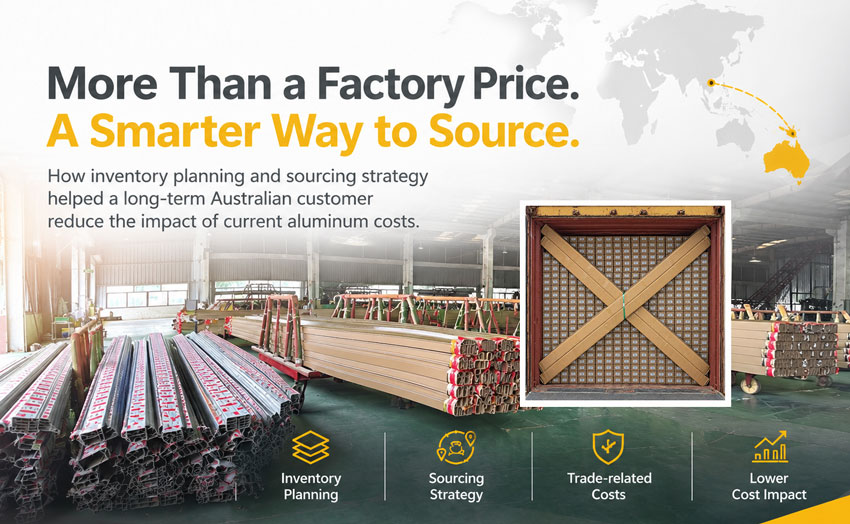
The Challenge: More Than a Factory Price
The customer needed another large quantity of their regular aluminum profiles.
At the same time, aluminum prices remained at relatively elevated levels. Import duties and trade-related costs were also important considerations for the Australian market.
Instead of looking only at the current production cost, we looked at the customer's long-term sourcing situation.
That gave us another way to manage the cost impact.
Planning Inventory for Future Demand
During previous production runs, we intentionally produced and retained additional quantities of the customer's regular profiles for potential future demand.
The retained inventory matched the specifications required for the new order.
When the customer placed the new order, we reviewed the available stock and identified suitable inventory that could be used for part of the order.
Some of this inventory had been produced under earlier aluminum cost conditions.
This meant the current order did not need to rely entirely on today's material costs.
Sourcing Strategy Also Matters
Inventory was only one part of the customer's long-term sourcing plan.
In our previous cooperation, we had also worked with the customer on a sourcing structure designed to reduce the impact of import duties and other trade-related costs.
For aluminum profiles entering Australia, sourcing location can be an important part of the total procurement equation.
The right solution therefore goes beyond:
“What is your factory price?”
It also considers:
“What will this product really cost to source?”
The Result: Value Beyond the Quotation
The customer placed a repeat order for:
100,000 pieces
USD 95,800
Australian market
By combining suitable retained inventory with the customer's existing sourcing strategy, we helped reduce the impact of current aluminum material costs on the new order.
We do not apply a standard saving percentage to every project. The actual benefit depends on the product, production history, inventory, sourcing structure, and market conditions.
What This Case Shows
For long-term aluminum profile sourcing, procurement cost is not always determined by today's factory price.
Previous sourcing decisions can create options for future orders.
At Ghonor, we look at:
Production Planning
Planning production with future demand in mind.
Inventory Management
Retaining suitable inventory that can support future customer requirements.
Sourcing Strategy
Considering production location and trade-related costs alongside the factory price.
Long-Term Supply Support
Using knowledge from previous orders to improve the next sourcing decision.
The goal is not simply to manufacture aluminum profiles. It is to help customers source them more efficiently over the long term.
Copyright © Foshan Golden Honor Decorative Material Co., Ltd.All Rights Reserved
Sitemap | Privacy Policy | Technical Support: